In short
- Glare is caused by luminance contrast: a bright source against a darker background in the field of view.
- UGR (Unified Glare Rating) is useful for regular office layouts but says little about homes, hotels, stairs and feature lighting.
- The most reliable glare control is geometric: hide the source, lower its luminance, and raise the brightness of its surroundings.
Two kinds of glare
- Discomfort glare: irritation and fatigue without loss of vision. The common problem in interiors.
- Disability glare: light scattered in the eye reduces contrast so you cannot see properly. Common outdoors, on stairs and with very bright point sources.
Both depend on how bright the source is, how large it appears, where it sits in the field of view and how dark the surroundings are.
What UGR does and does not tell you
- UGR is a calculated value for a defined observer position in a regular room with a regular grid of luminaires.
- Lower is better; office guidance commonly uses limits around 19 for desk work (check the applicable standard for your project).
- It does not handle well: very small, very bright sources such as narrow spots; irregular layouts; reflected glare on screens and polished floors; lying or seated positions in homes; stairs and double-height views.
A low UGR on a data sheet is a starting point, not a guarantee.
Designing glare out
Hide the source
- Deep recess and cut-off angle: the deeper the source sits in the fitting, the wider the range of viewing angles from which it is hidden. Dark-light or low-luminance reflectors reduce brightness further.
- Baffles, louvres and honeycomb: reduce direct views of the source at oblique angles.
- Position: keep bright sources out of common sightlines, such as directly above a sofa or bed, or in the view from a stair.
Lower the source luminance
- Larger, diffused sources at the same output are less glaring than small, intense ones.
- Opal and recessed diffusers in linear profiles reduce visible brightness. See Opal, Frosted or Lens.
- Dimming lowers luminance; evening scenes often solve daytime glare problems.
Raise the surroundings
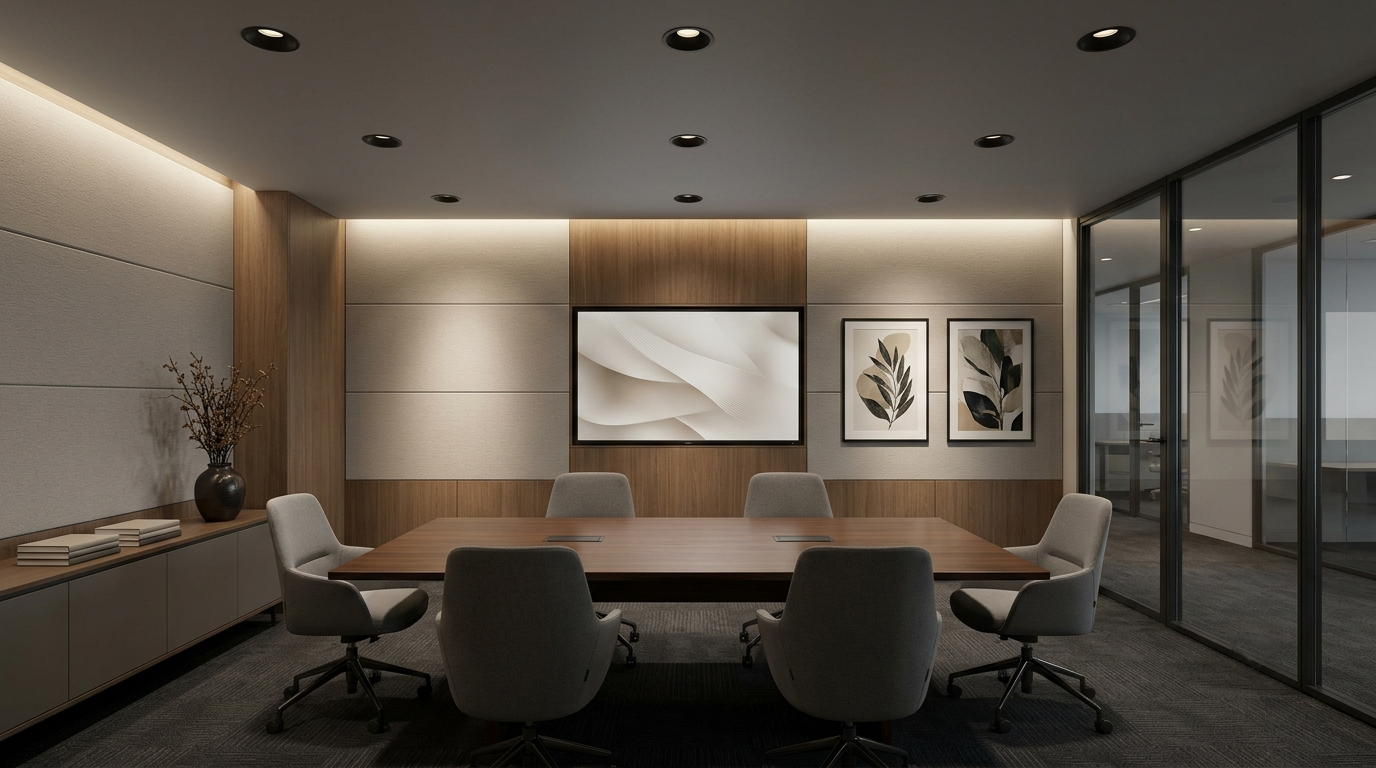
- Glare depends on contrast. A bright downlight against a dark ceiling is worse than the same downlight in a room with lit walls.
- Lighting vertical surfaces reduces contrast and perceived glare. See Light the Walls.
Reflected glare
- Polished stone and marble floors mirror downlights. Offset fittings from main views or use larger, lower-luminance sources.
- Glossy ceilings and stretch ceilings mirror strips and spots.
- Screens and glass: position fittings outside the mirror angle from the viewer’s eye to the screen.
- Kitchen counters: granite and quartz reflect under-cabinet strips; set strips towards the front and use diffusers.
Space by space
| Space | Main glare risk | Response |
|---|---|---|
| Living room | Downlights in view from seating | Deep-recessed, low-luminance fittings; light walls |
| Bedroom | Sources above the bed in the lying eyeline | No downlights directly over the bed; indirect light |
| Office | Screens and long rows of fittings | Low-UGR fittings, wall light, screen-aware positions |
| Stairs and double height | Sources visible from above | Check views from every level; shielded fittings |
| Exterior | Bright sources in dark surroundings | Low luminance, shielding, aim away from viewers |
| Puja room | Downlight above the deity in seated view | Hide sources from the seated eye; see puja room lighting |
Specification notes
- Use UGR for regular office layouts; use geometry and mock-ups everywhere else.
- Specify cut-off angle, recess depth and reflector finish for accent and downlights.
- Check sightlines from seated, lying and upper-level positions.
- Light vertical surfaces to reduce contrast.
- Identify reflective surfaces (polished floors, screens, glossy ceilings) and position fittings outside mirror angles.
Frequently asked questions
What is a good UGR value?
For office desk work, a commonly used limit is around 19, with lower values for more demanding tasks. Check the standard that applies to your project; UGR is less useful in homes and hospitality.
Why do LED downlights feel so glaring?
LED sources are small and intense. Without deep recessing, low-luminance reflectors or diffusers, the source is visible from many angles, and a dark ceiling increases the contrast.
How do I reduce glare from downlights at home?
Use deeply recessed fittings with good cut-off, avoid placing them above seating and beds, dim them in the evening, and add light on walls to reduce contrast.
Continue the series
- The Colour of Light
- One Wall, Two Whites
- Beam Angle in Office Lighting
- Light the Walls
- Darkness as a Design Material
About the author
Prem Rout, Founder of JMAP Solutions, set up in 2022 to deliver lighting, automation and building management solutions from Bhubaneswar. Over 15 years of experience in building products, construction and project business development across Mumbai and Odisha, working where design intent meets specification and site delivery. Connect on LinkedIn.


