In short
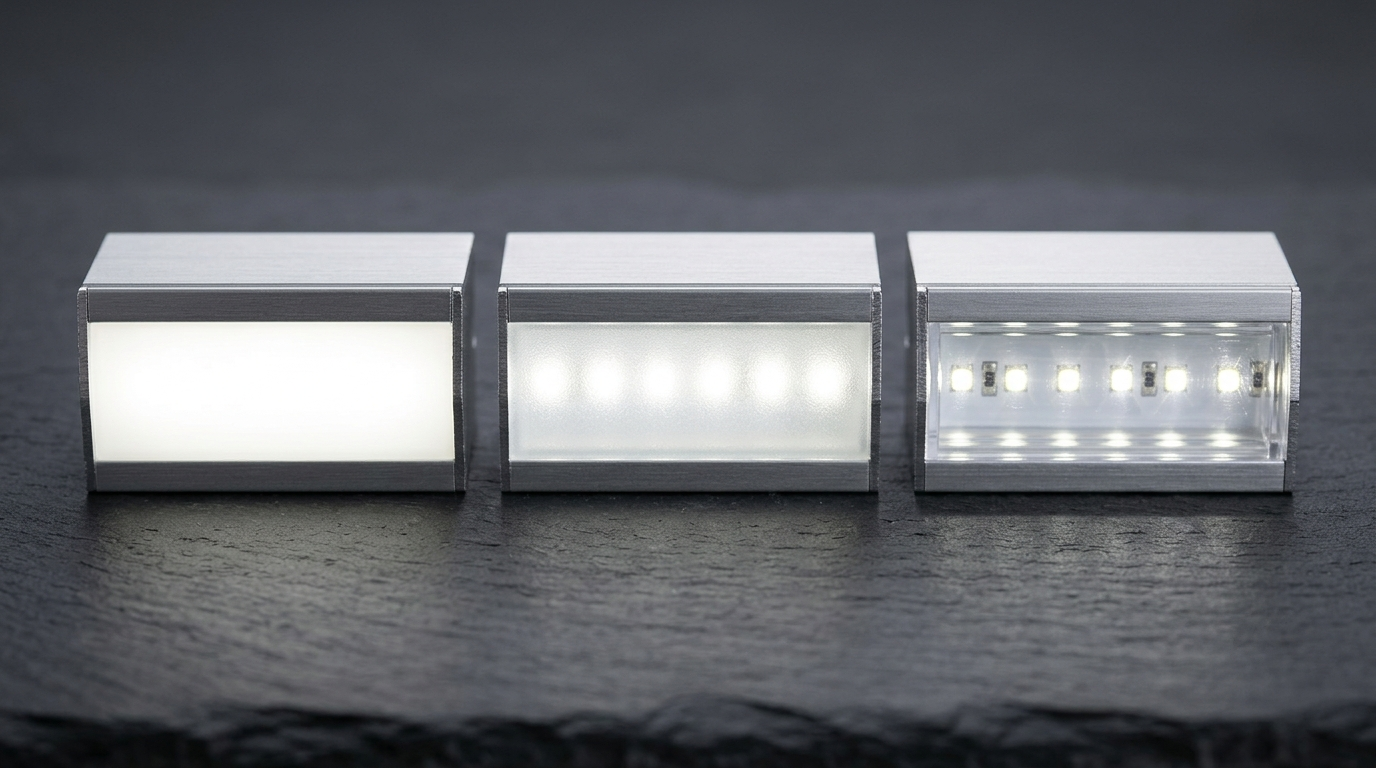
- A diffuser trades efficiency for evenness. Opal hides dots but absorbs light; clear passes light but shows every LED.
- Lenses change distribution: they aim light onto a wall, a desk or a counter rather than spreading it everywhere.
- Choose the optic by what the viewer sees and what the light must do, then size output for the loss through the diffuser.
Two jobs for one component
The diffuser or lens on an LED profile does two things at once:
- Appearance: whether the line reads as a smooth glow, a bright stripe or a row of dots.
- Distribution: where the light goes, from a broad spread to a tight beam aimed at a surface.
The four decisions behind every profile (mounting, optic, output, heat) are set out in Light as a Line.
The options
| Optic | Appearance | Light output | Distribution | Best for |
|---|---|---|---|---|
| Opal | Smooth, even glow; no dots | Lowest; significant loss | Very wide, diffuse | Visible lines, joinery, pendants |
| Frosted / satin | Brighter, mostly even | Medium | Wide | Visible lines where output matters |
| Clear | Visible LED dots | Highest | Strip’s own spread | Hidden coves, uplight where the source is not seen |
| Lensed (narrow, oval, asymmetric) | Bright line or points | High, directed | Controlled beam | Wall grazing, washing, task light from a slot |
| Deep-set / recessed diffuser | Glow set back from the face | Lower | Narrower cut-off | Low-glare visible lines, offices |
| Microprismatic | Controlled brightness | Medium | Shaped, low glare | Offices, suspended profiles |
Diffuser losses vary widely by product. Use the photometric data of the complete profile, not the strip.
Dots and evenness
Visible dots depend on three factors:
- LED pitch: the spacing of LEDs on the strip. High-density strips (or COB strips) reduce dots.
- Distance to the diffuser: a deeper profile gives light more room to blend.
- Diffuser type: opal blends most, clear least.
A shallow profile with a low-density strip and a frosted cover will show dots. A deep profile with a high-density strip and opal will not.
Glare from visible lines
- A visible line is a light source in the field of view. Opal and deep-set diffusers lower its luminance.
- Suspended profiles over desks or dining tables need optics that limit brightness at viewing angles. See Glare Beyond UGR.
- Very bright lines in a dim evening room feel harsh. Dim them, or use lower output per metre for visible lines.
Lensed optics
- Asymmetric lenses push light to one side, for grazing or washing a wall from a ceiling slot.
- Narrow lenses concentrate light for long throws or task light from a high ceiling.
- Oval or elliptical lenses spread light along a surface and narrow it across.
Practical choices
- Under-cabinet in a kitchen: frosted or opal, with the profile near the front edge. See The Kitchen and the Dining Table.
- Cove: clear or frosted is fine because the source is hidden. See Cove Details.
- Trimless ceiling slot: opal for a glowing line; lensed for a wall graze. See Slots, Shadow Gaps and Joinery.
- Shelves and wardrobes: opal, deep-set from the shelf edge.
- Office suspended: microprismatic or deep-set opal for low glare.
Durability and maintenance
- Polycarbonate diffusers resist impact; PMMA (acrylic) offers good clarity but is more brittle.
- Some diffusers yellow over time with UV and heat. Ask about UV stability for daylight areas.
- Snap-in diffusers should be removable for cleaning and strip replacement.
Specification notes
- Choose the optic by visibility of the source and the surface to be lit.
- Specify lumens per metre of the complete profile with its diffuser.
- Combine high-density strips, adequate depth and opal where dots must not show.
- Use lenses for grazing, washing and long throws.
- Check UV stability and removability of diffusers.
Frequently asked questions
Which diffuser hides LED dots best?
Opal, especially in a deeper profile with a high-density or COB strip. Frosted reduces dots; clear does not hide them.
How much light does an opal diffuser lose?
It varies by product and can be significant. Always use the photometric data of the complete profile rather than the strip’s rated output.
When should I use a lens instead of a diffuser?
When light must reach a specific surface, such as grazing a wall, washing from a slot or lighting a desk from a high ceiling.
Continue the series
- Light as a Line: Linear LED Profiles
- Cove Details That Don’t Show
- Slots, Shadow Gaps and Joinery
- Backlit Stretch Ceilings
About the author
Prem Rout, Founder of JMAP Solutions, set up in 2022 to deliver lighting, automation and building management solutions from Bhubaneswar. Over 15 years of experience in building products, construction and project business development across Mumbai and Odisha, working where design intent meets specification and site delivery. Connect on LinkedIn.


