In short
- A lighting design that cannot be controlled as intended is experienced as one bright scene. Control is what makes layers, contrast and mood usable.
- Circuit by role (accent, architectural, task, ambient), not by room or by switch position. This one decision fixes most control problems later.
- Choose the control language at concept stage. Changing from phase-cut dimming to DALI or DMX after first-fix wiring is expensive.
Control is a design layer
Every design in this journal, from beam angle to colour temperature, assumes that light can be set to different levels for different moments. Without control, a carefully layered scheme collapses into everything on at full output.
Control determines:
- Contrast: an accent only reads as an accent when the ambient level is lower.
- Time: the same room serves a bright morning, a family evening and a late quiet hour.
- Energy and life: dimmed LEDs run cooler and last longer; unoccupied rooms switch off.
- Usability: a client who cannot find the right switch defaults to “all on”.
1. Circuit by role, not by room
The most consequential control decision is how fittings are grouped.
- Accent: narrow beams on art, objects, niches. Usually the most dimmed layer.
- Architectural: coves, wall washes, grazing, slots. Sets the perceived volume.
- Task: kitchen counters, reading lights, desks. Needs full output on demand.
- Ambient: downlights or indirect fill. Often the least needed in the evening.
- Decorative: pendants, chandeliers, lamps. Kept separate because they are seen, not just felt.
A living room with five roles needs at least five control channels, even if it has only two switch positions. Each role should dim independently.
Common mistake: circuiting all downlights together because they are the same product. A downlight over a sofa and a downlight lighting art do different jobs.
2. The control language
Fittings and drivers speak a control language. The choice decides wiring, addressability and cost.
| Protocol | How it works | Strengths | Limits | Typical use |
|---|---|---|---|---|
| Phase-cut (leading/trailing edge) | Dims the mains supply | Simple, existing wiring | Compatibility issues, flicker at low end, no individual addressing | Small retrofits |
| 0–10 V / 1–10 V | Separate low-voltage control pair | Smooth, widely supported | Extra wiring, one level per circuit | Offices, simple commercial |
| DALI | Two-wire digital bus, each driver addressable | Individual control, feedback, scenes, flexible regrouping | Needs a DALI system and commissioning | Premium residences, offices, hospitality |
| DMX512 | Digital protocol from stage lighting | Fast, many channels, colour and effects | Wiring topology, commissioning, overkill for static white | Facades, colour-changing, dynamic installations |
| Wireless (Bluetooth mesh, Zigbee) | Radio, no control wiring | Retrofit-friendly | Reliability depends on network; app-dependent | Retrofits, small apartments |
The decision table by project type is in our protocols guide. In short: DALI is the sensible default for premium new residences, DMX belongs to colour and facades, and phase-cut belongs to small budgets and retrofits.
3. Scenes: designing moments, not switches
A scene is a stored combination of levels across all roles. It turns a lighting design into something a client can use with one press.
Typical residential scenes:
- Morning: task and ambient up, accent off, cooler if tunable.
- Day: low, supporting daylight.
- Evening: architectural and accent up, ambient down. The scene the design is judged by.
- Entertaining: brighter architectural light, all accents on.
- Puja: focused warm light on the shrine, surrounding light low.
- Cinema: everything low except a bias light behind the screen and a floor path.
- Night path: low-level light to the bathroom or kitchen.
The full scene matrix, with levels per role, is in Scenes, Not Switches. Scenes are also how voice control in Hindi or English becomes useful: “evening” is easier to say than five dimmer levels. See our Scene Control work.
4. Sensors and daylight
- Presence and absence sensing for bathrooms, corridors, stores and offices. Absence mode (manual on, automatic off) avoids lights switching on when not wanted.
- Daylight-linked dimming keeps illuminance steady near windows and is most useful in offices.
- Astronomical time clocks for exterior and facade scenes, so the building wakes at dusk without anyone setting a timer.
5. Dimming quality is part of the control design
A control system is only as good as the drivers it commands.
- Minimum dim level: for evening and night scenes, drivers should dim smoothly to 1% or lower without stepping.
- Flicker: some drivers flicker at low levels, visible on camera and to sensitive people.
- Dim-to-warm: fittings that warm as they dim, like incandescent lamps, suit hospitality and dining.
Our dimming quality guide covers what to test at mock-up.
6. Keypads and interfaces
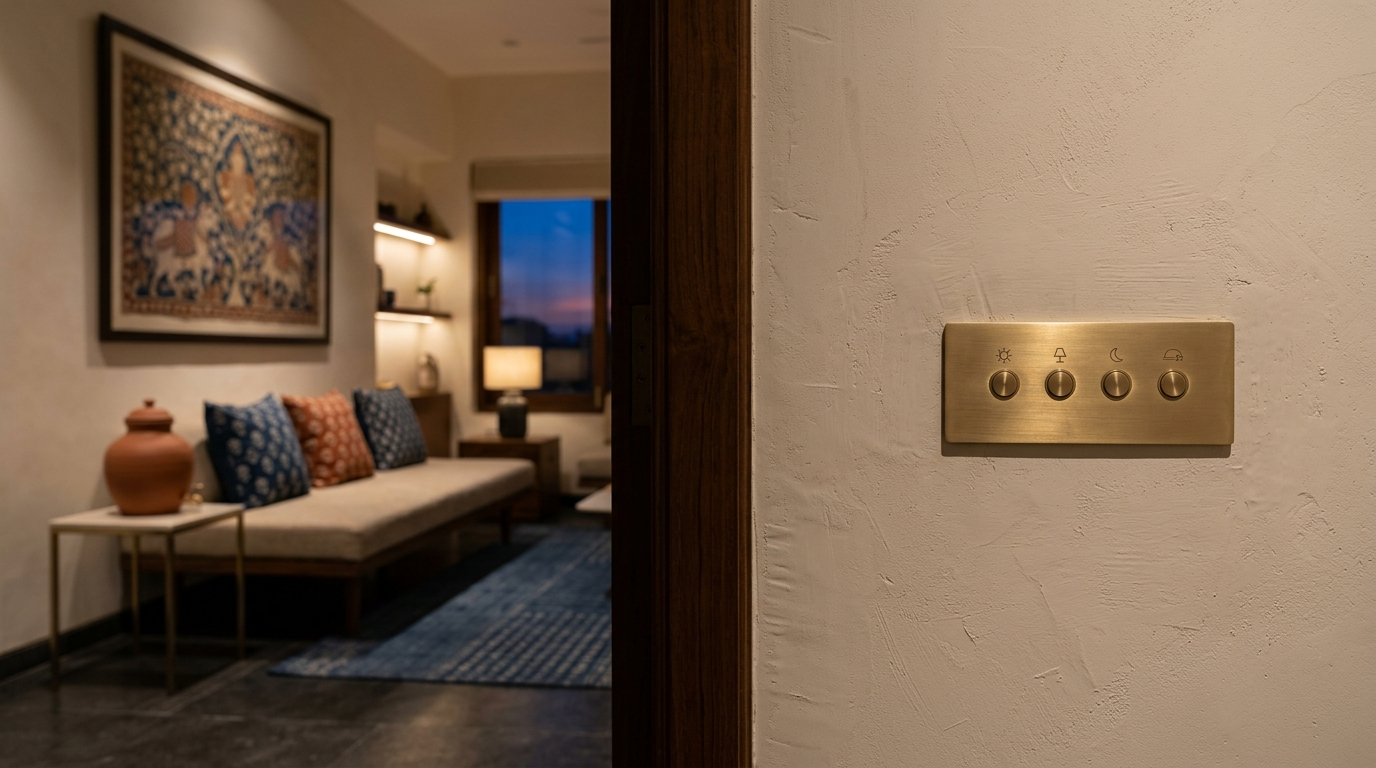
- Fewer buttons, clearer labels. A four-scene keypad at the entry is used; a twelve-button panel is ignored.
- Engraved scene names, not numbers.
- Consistent location: the same scene in the same position on every keypad in the house.
- App and voice as additions, not replacements. A guest or household staff must be able to use the house without a phone.
- Hindi and regional-language voice control is now practical and helps households where not everyone uses English. See Voice Control.
7. What to freeze at concept stage
Control decisions affect wiring, so some must be made before electrical drawings are issued.
- Control protocol per area (DALI, phase-cut, DMX, wireless).
- Circuiting by role for each room.
- Keypad positions and the scenes on each.
- Sensor positions and modes.
- Space for control panels and driver access in ceilings and joinery.
- Integration with curtains, AC and AV if a single system is intended.
8. Indian context
- Power quality: voltage fluctuation and frequent changeovers to inverter or DG supply can upset sensitive drivers and some phase-cut dimmers. Specify drivers with suitable input range and test on site power.
- Inverter loads: decide which circuits stay on inverter backup. Usually a minimum of architectural and path light, not every accent.
- Household staff: design scenes and keypads for everyone who uses the house, not just the owner.
- Retrofits: where re-wiring is not possible, wireless control can add scenes to existing circuits.
Specification notes
- Circuit every room by role: accent, architectural, task, ambient, decorative.
- Fix the protocol per area before electrical drawings; default to DALI for premium new residences.
- Define scenes with levels per role on the lighting schedule.
- Specify drivers by minimum dim level and flicker performance, not just protocol.
- Place a simple scene keypad at each room entry; engrave scene names.
Frequently asked questions
When should I decide the lighting control system?
At concept design, before electrical drawings. The protocol and circuiting determine cable types, panel space and driver choice, which are costly to change after wiring.
Is DALI worth it for a residence?
For premium new residences with layered lighting, usually yes. Individual addressing lets you regroup fittings and refine scenes after handover without rewiring.
What is the difference between a scene and a dimmer?
A dimmer sets one circuit. A scene stores levels for every circuit in a room and recalls them together with one press or one voice command.
Can I add smart lighting control without rewiring?
Often yes, using wireless control on existing circuits. It is less granular than a wired system but can add scenes and app control to an existing home.
Continue the series
- Scenes, Not Switches: A Scene Matrix for the Indian Residence
- Phase-Cut, 0–10 V, DALI or DMX: Choosing the Control Language
- Dimming Quality: Flicker and the Low End
- Tunable White and Circadian Claims
- The Colour of Light: CCT, CRI and TM-30
About the author
Prem Rout, Founder of JMAP Solutions, set up in 2022 to deliver lighting, automation and building management solutions from Bhubaneswar. Over 15 years of experience in building products, construction and project business development across Mumbai and Odisha, working where design intent meets specification and site delivery. Connect on LinkedIn.


