The room where people look up
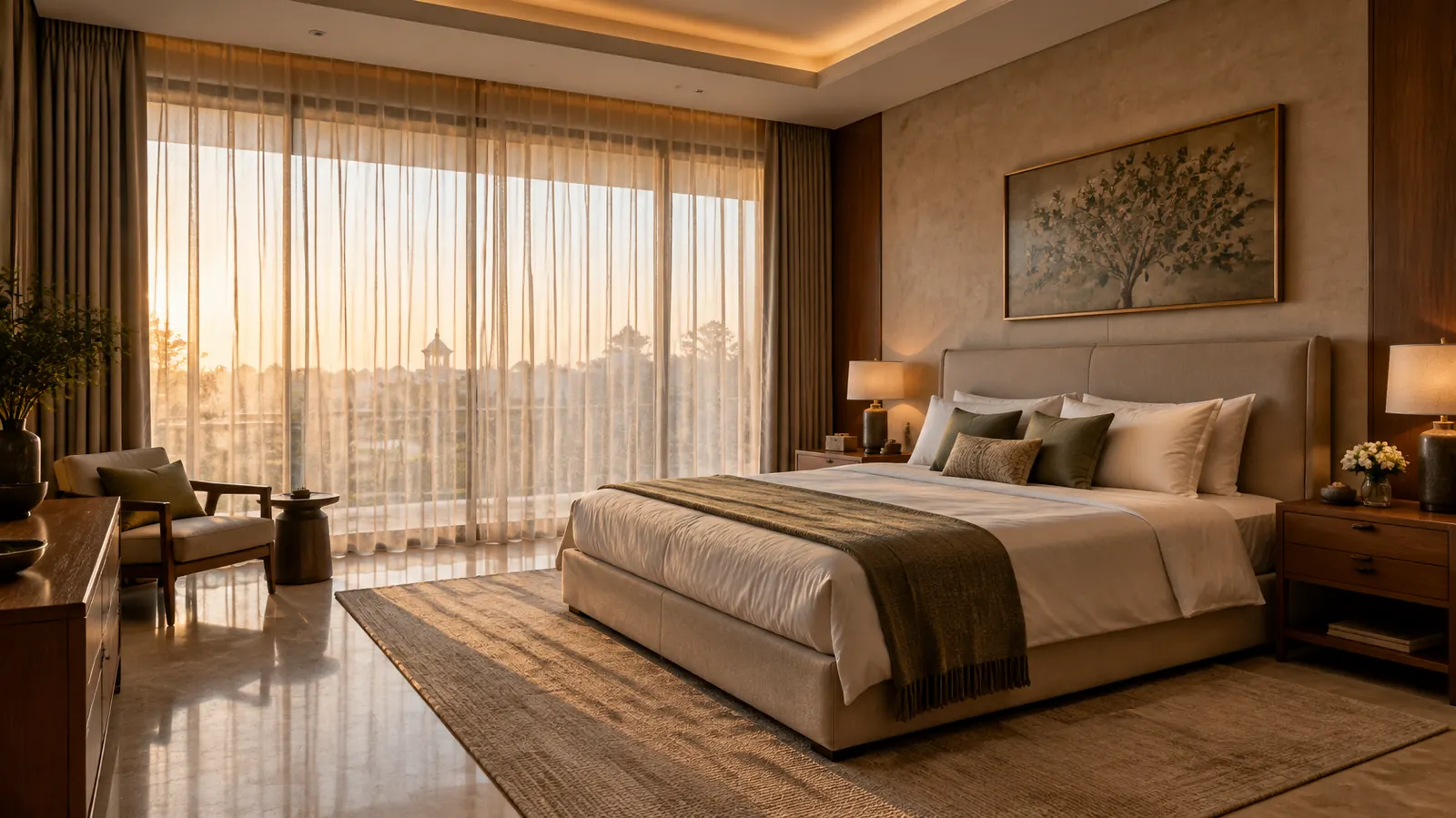
Every other room is designed for a standing or seated viewer whose eyes run roughly horizontal. Shielding angles, glare ratings and fitting positions all assume that. The bedroom breaks the assumption: for hours at a time the occupant lies on their back, looking directly at the ceiling.
A downlight that is invisible from the doorway becomes a bright disc in the centre of the field of view from the pillow. The bedroom therefore asks for a different beam strategy. Fewer, narrower, better-shielded beams, placed by sightline rather than by grid.
This guide applies the principles in our beam angle and optics guide to the bedroom. It covers:
- How the reclined sightline changes fitting placement.
- A beam schedule for each layer: headboard, reading, wardrobe, art, dressing and night path.
- Contrast and edge quality for a room designed for rest.
- Indian ceiling and void constraints that affect the optic choice.
1. The reclined sightline
From a lying position, the eye looks up at the ceiling above and slightly beyond the head. Any source in that cone of view is seen directly, and no recess depth hides a source you look straight into.
- No-downlight zone: keep the ceiling directly above the pillows and the upper half of the bed free of downlights. This is the area seen face-on from the pillow.
- Preferred positions: beyond the foot of the bed, along the wardrobe wall, and over bedside tables offset towards the headboard wall.
- Tilt away from the bed: adjustable spots near the bed should aim away from it, at the headboard wall, art or wardrobe, never back towards the pillow.
- Check from the pillow: review the reflected ceiling plan from the lying position as well as from the door. A 3D view from pillow height catches most problems.
- Ceiling as a surface, not a source: indirect cove light lets the ceiling read as a soft glow without any visible point source. See cove lighting.
2. A beam schedule for the bedroom
Start from the layers, then assign the beam. The angles below are typical starting points for a 2.7–3.0 m ceiling; confirm with throw distance and the beam spread calculator.
| Layer | Intent | Typical beam | Optic | Position |
|---|---|---|---|---|
| Headboard wall | Texture and focus | Narrow, 10–20°, or linear graze | TIR or narrow-lens profile | Close to the headboard wall |
| Bedside reading | Light on the page only | Narrow, 10–15° | TIR, well shielded | Over the side table or wall-mounted near the head |
| Wardrobe face | Even vertical light | Asymmetric wash | Wall-wash reflector or lens | Set back from the shutters |
| Inside wardrobe | See colours accurately | Linear, wide cross-section | Diffused profile | Shelf fronts or side uprights |
| Artwork | Gentle accent | Narrow to medium, sized to the work | Faceted reflector or TIR | About 30° from vertical |
| Dressing / vanity | Even light on the face | Wide, diffused | Opal or linear diffuser | Either side of the mirror |
| Night path | Orientation without waking | Wide, asymmetric, downward | Low-level step or plinth light | Near floor, aimed away from the bed |
| General | Soft background | Indirect | Cove profile | Ceiling perimeter |
The general layer is deliberately listed last. In most bedrooms, indirect cove light plus the accent layers removes the need for a downlight grid entirely.
3. The headboard wall
The headboard wall is usually the strongest architectural surface in the room and the one seen when entering.
- Textured headboards (fluted timber, upholstered panels, stone, cane): graze with a narrow beam or a linear profile close to the wall. The texture reads in relief.
- Smooth or lacquered headboards: grazing exposes every ripple and reflects the source. Wash with a softer, wider beam from a slightly larger offset, or light the wall above the headboard instead.
- Keep light off the pillow: aim the graze to land on the headboard and the wall above it. A narrow beam that spills down onto the pillows puts the brightest patch exactly where the head rests.
- Recessed linear slot: a narrow-beam profile in a ceiling slot along the headboard wall gives a continuous, scallop-free graze. See LED Profiles.
- Edge quality: a soft edge suits upholstery and timber. A hard edge reads graphic and suits stone or a single strong material.
4. Reading light without disturbing a partner
Reading needs a small, bright pool on the page and nothing on the next pillow. This is a beam-angle problem first.
- Size the pool to the book, not the bed. At a throw of about 2.2 m from the ceiling to a book held at chest height, a 15° beam gives a pool of roughly 0.58 m; a 10° beam about 0.38 m. Anything wider starts to reach the other side of the bed.
- Closer is better. A wall-mounted adjustable reader near the head, with a narrow, well-shielded optic, delivers the same illuminance at a fraction of the output and does not light the room.
- Shield the source. The reader is directly beside the face of the person next to it. Deep-set optics or a snoot keep the aperture dark from the other pillow.
- Separate control. Each side of the bed on its own switch or dimmer, at the bedside. A bedtime scene can switch off everything else in one touch.
5. Wardrobes and dressing
Wardrobes carry two very different briefs: the shutters as an architectural surface, and the inside as a place to judge colour.
- Shutter faces: an asymmetric wall-wash optic set back from the wardrobe gives even light from top to bottom. A row of symmetric downlights close to the shutters leaves scallops on every panel.
- Lacquered or glossy shutters: they act as mirrors. Check that the bright apertures do not reflect into the view from the bed.
- Inside the wardrobe: linear profiles on the shelf fronts or uprights, with diffused optics, light the contents rather than the top shelf. Use high colour rendering so fabrics read true.
- Mirror and vanity: light the face from the front and sides with wide, diffused sources. A narrow downlight above a mirror casts shadows under the eyes and chin, which is the opposite of what a dressing area needs.
6. Contrast for a room of rest
Bedrooms read best with gentle hierarchy, not drama.
- Lower ratios: accent-to-ambient ratios towards the gentle end of the conventions in the pillar guide (around 2:1 to 5:1) feel restful. Strong 15:1 drama suits a living room or a lobby, not a bedroom.
- Soft edges: feathered beams blend into the ambient light. Hard-edged pools on a bedroom wall feel like a gallery.
- Warmer colour temperature for evening layers, consistent across every fitting lighting the same surface.
- Dimming on every layer: a bedroom is used from bright morning dressing to near-dark reading. Each layer should dim smoothly to a very low level without flicker.
- Fewer sources: every additional beam adds another bright patch to a room that should feel calm. Remove a fitting before adding one.
7. Glare and optic choice
- Deep recess and dark-light optics for any fitting within view of the bed. The shielding that works in a living room is often not enough when the viewer lies down.
- Adjustable fittings with a lockable aim so cleaning does not swing a beam back towards the pillow.
- Low-luminance trims: a black or dark-light trim reads quieter on a white ceiling than a polished reflector at night.
- Avoid exposed point sources above the bed. A pendant over a bedside table should have its source shielded from both the standing and the lying eye.
8. Ceiling heights and voids in Indian bedrooms
- 2.7–3.0 m after the false ceiling is common in apartments. At these heights, narrow beams make small pools; the reading-light numbers above assume this range.
- Shallow voids under beams and ducts may not take deep-recessed housings. Plan bulkheads around the headboard or wardrobe walls early, and use them for slots or coves.
- Downstand beams often cross bedrooms. Align accent fittings and slots with the beam lines rather than fighting them.
- Split AC units and ducts take up ceiling and wall positions near the bed. Coordinate fitting positions with the AC drawing before the ceiling closes.
9. Night path lighting
- Low-level, wide, downward light at plinth or step height lets someone reach the bathroom without switching on the room.
- Aim away from the bed and use very low output. The aim is orientation, not visibility.
- Motion activation with a slow fade-in avoids a sudden bright light at night.
Specification notes
- Draw a no-downlight zone over the pillows on the reflected ceiling plan.
- Size the reading beam to the book: about 10–15° from a 2.7–3.0 m ceiling, or a wall-mounted narrow reader.
- Graze the headboard with a narrow beam or linear profile, and keep the spill off the pillows.
- Wash wardrobe shutters with asymmetric optics, not a downlight row.
- Light vanity mirrors from the front and sides with diffused sources.
- Keep accent ratios gentle, edges soft, and every layer dimmable.
- Check every sightline from the pillow as well as the door.
Frequently asked questions
Should I put downlights above the bed?
Generally no. The area directly above the pillows is seen face-on when lying down, so any downlight there reads as glare. Light the headboard wall, use indirect cove light, and place downlights beyond the foot of the bed or along the wardrobe wall instead.
What beam angle is best for a bedside reading light?
A narrow beam, typically around 10° to 15° from a 2.7–3.0 m ceiling, keeps the pool to the size of a book and off the other pillow. A wall-mounted adjustable reader with a narrow, well-shielded optic is often better still.
How do I light a fluted or upholstered headboard?
Graze it with a narrow beam or a linear profile placed close to the wall, aimed to land on the headboard and the wall above it. Keep the spill off the pillows, and choose a soft-edged beam for fabric and timber.
Why do my wardrobe shutters show arches of light?
Downlights placed close to a vertical surface create scallops. Use an asymmetric wall-wash optic set back from the shutters, or move the fittings further from the wardrobe.
Continue the series
- Beam Angle in Lighting Design: Optics, Lenses and the Architecture of Light
- Beam Angle in Living Spaces: Volume, Art and Vertical Surfaces
- Beam Angle in Workspaces: Glare Control, Task Planes and Faces on Camera
Designing a residence in Bhubaneswar, Cuttack or elsewhere in Odisha? Book a free consultation and we will plan the bedroom beam schedule with your design team.
About the author
Prem Rout, Founder of JMAP Solutions, set up in 2022 to deliver lighting, automation and building management solutions from Bhubaneswar. Over 15 years of experience in building products, construction and project business development across Mumbai and Odisha, working where design intent meets specification and site delivery. Connect on LinkedIn.