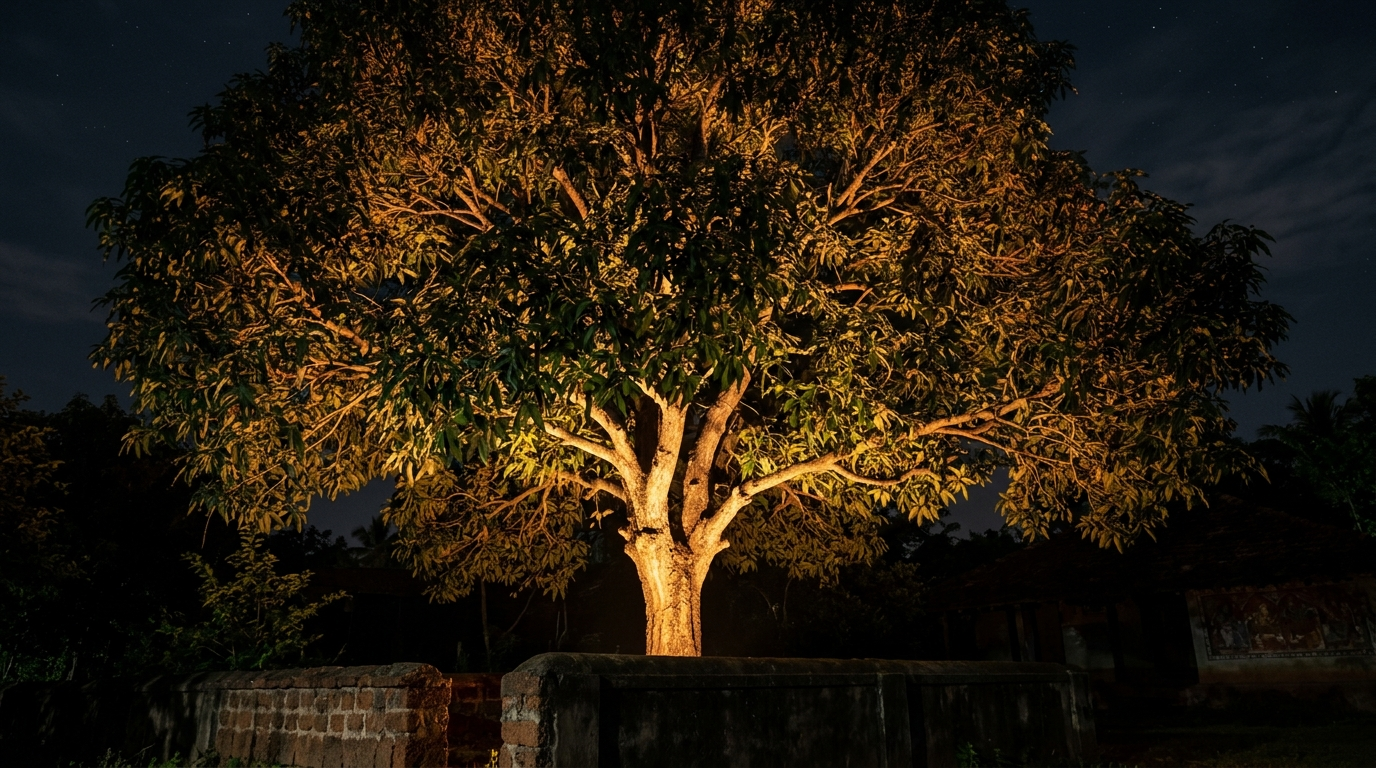
In short
- Light the tree for its form: a spreading canopy, a sculptural trunk or a vertical palm each need a different approach.
- Position and beam decide everything. Wide beams close in light the canopy underside; narrow beams further out reach the crown.
- Trees grow and gardens change. Use adjustable, accessible fittings and re-aim after the monsoon.
Why trees matter at night
In a dark garden, lit trees provide depth: foreground, middle ground and background. They frame the building and extend views from inside. Without them, a lit facade sits alone in a black field.
How trees fit into the overall exterior scheme is covered in The Night Image.
Three techniques
Uplighting
- Fittings at the base light the trunk and the underside of the canopy.
- Dramatic and sculptural; the most common technique.
- Risks glare if fittings are visible, and spill into the sky above open canopies.
Moonlighting (downlighting)
- Fittings mounted high in the tree shine down through branches, casting dappled shadows on the ground.
- Natural and soft, like moonlight; excellent for lawns, paths and seating areas.
- Needs fixing in the tree and access for maintenance; fittings must be secured against wind.
Silhouetting
- Light the wall or surface behind the tree, leaving the tree dark against it.
- Works for sculptural trees and palms against a building or boundary wall.
By tree form
| Tree type | Example in Odisha gardens | Approach |
|---|---|---|
| Broad, spreading canopy | Mango, neem, banyan, rain tree | Two or three wide uplights within the drip line, aimed into the canopy; moonlight from above for seating below |
| Sculptural trunk | Frangipani, old mango | Narrow uplight grazing the trunk; low output on the canopy |
| Vertical palm | Coconut, areca, royal palm | Narrow uplight close to the trunk to reach the crown; or silhouette against a wall |
| Dense, small tree | Citrus, hibiscus | Single wide, low-output uplight from the front |
| Feature tree near the house | Champa, kadamba | Light from the viewing side; avoid glare from inside windows |
Positioning and beams
- Close to the trunk: grazes bark texture; narrow beams reach high.
- At the drip line: lights the canopy underside; wide beams fill it.
- Outside the canopy: washes the front face of the tree; useful for dense foliage.
- Two or more fittings avoid a flat look and reveal depth.
- Aim from the main viewpoint so fittings point away from viewers.
Beam choice follows the same principles as interiors; see our beam angle guide.
Colour
- Warm white (2700–3000 K) flatters bark and many foliage types and matches residential facades.
- Slightly cooler white (around 4000 K) can make dense green foliage look fresher, but mixing it with a warm facade looks accidental.
- Avoid coloured light on trees except for deliberate festival scenes.
Detailing for Indian gardens
- Monsoon: in-ground fittings need drainage below; above-ground spike fittings with glare shields are easier to maintain.
- Growth: spike-mounted, adjustable fittings can be moved and re-aimed as trees grow.
- Cables: protected in conduit, buried at a safe depth and recorded on a plan so gardeners do not cut them.
- Insects: lit trees attract insects. Avoid lighting trees right next to seating and windows, and use a late-night off scene.
- Ingress and impact: fittings near lawns face mowers and footfall. See Coastal Exterior Lighting: IP, IK and Salt Air.
Wildlife and the night sky
- Lighting entire canopies all night affects birds, bats and insects. Light fewer trees, at lower levels, for shorter hours.
- Aim into the canopy, not past it into the sky. See Light Spill and Dark Skies.
Specification notes
- Select trees to light by their role in the view, not all trees.
- Choose technique (uplight, moonlight, silhouette) by tree form.
- Use two or more fittings for large canopies; aim away from viewpoints.
- Specify warm white by default; avoid mixing temperatures across the garden.
- Use adjustable spike fittings with glare shields; record cable routes.
- Schedule a late-night off scene; re-aim after each monsoon.
Frequently asked questions
How do you uplight a large tree?
Use two or three wide-beam fittings at or inside the drip line, aimed into the canopy from the main viewing side. Add a narrow beam close to the trunk if the bark is worth revealing.
What is moonlighting in landscape lighting?
Mounting fittings high in a tree and aiming down through the branches, creating dappled shadows on the ground like moonlight.
How do you light palm trees?
A narrow-beam uplight close to the trunk reaches the crown. Alternatively, silhouette the palm against a lit wall behind it.
Continue the series
- The Night Image
- Facade Grazing on Stone and Laterite
- Coastal Exterior Lighting
- Light Spill and Dark Skies
About the author
Prem Rout, Founder of JMAP Solutions, set up in 2022 to deliver lighting, automation and building management solutions from Bhubaneswar. Over 15 years of experience in building products, construction and project business development across Mumbai and Odisha, working where design intent meets specification and site delivery. Connect on LinkedIn.


