In short
- At night, a building is only what you choose to light. Decide the night image before choosing a single fitting.
- Light less, but better. A few well-placed elements read stronger than a facade washed from end to end.
- Exterior lighting is a layered system: facade, landscape, paths and entries, each with its own purpose, control and maintenance.
The building after dark
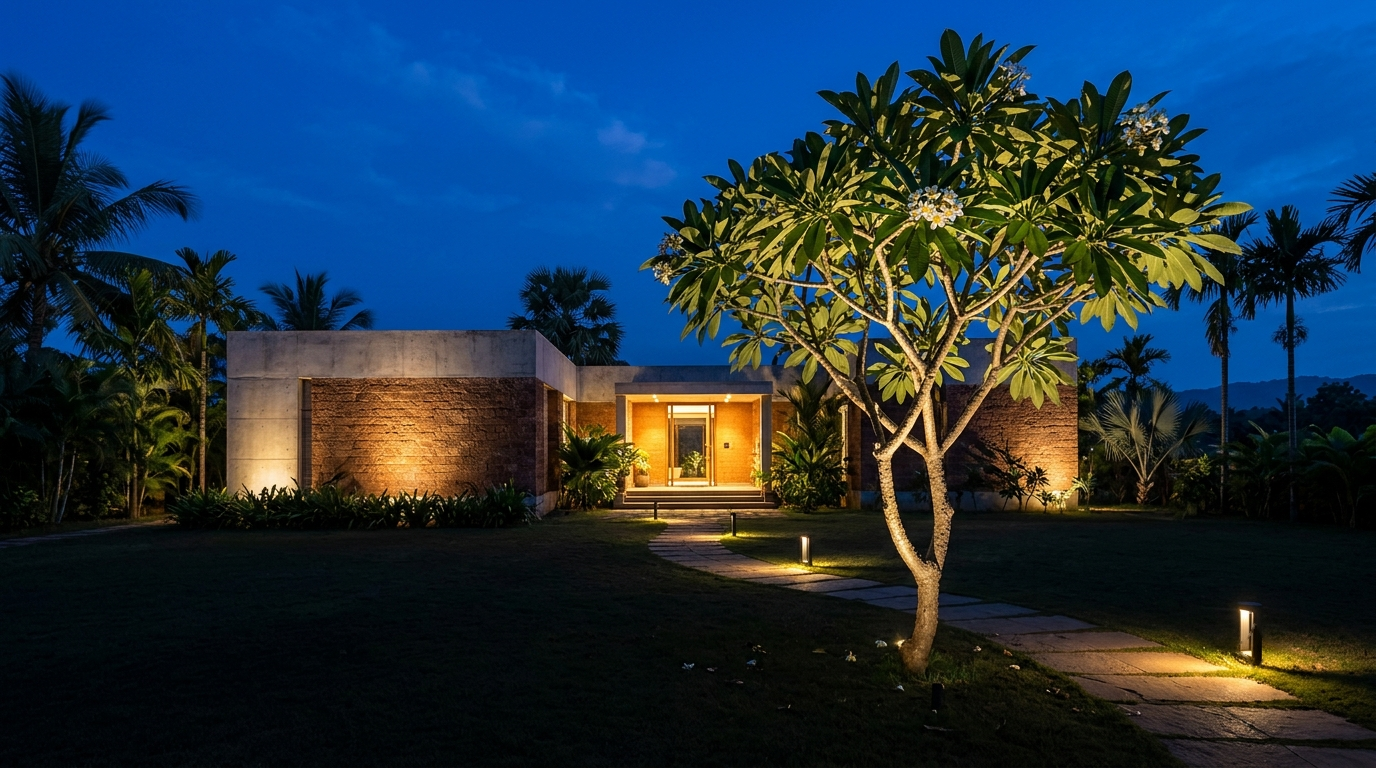
By day, a building is read through sunlight: volume, shadow, material and context. After dark, all of that disappears except what is lit. The designer decides what the building becomes.
- A villa can become a series of glowing planes and silhouetted trees.
- A hotel can lead guests from the gate to the entrance with a sequence of light.
- A commercial facade can be read from the road as one strong, simple gesture.
Without a decision, the default is floodlights, which flatten everything and light the sky.
1. Decide the night image first
Before fittings, answer:
- What should be seen from the approach? The gate, the road, the entrance court.
- What is the hierarchy? One element should be brightest; everything else supports it.
- What should stay dark? Darkness gives contrast, privacy and depth.
- Who uses the space and when? Arrivals, evening gatherings, security at 2 am.
A night image is often best explored as a sketch or a darkened rendering of the elevation, marking only the lit surfaces.
2. The layers
Facade
- Grazing for texture, washing for evenness, accenting for features.
- Light from inside (windows, screens, jaali) is part of the facade at night.
- Detail in Facade Grazing on Stone and Laterite. Our Facade Lighting work covers villas and commercial buildings.
Landscape
- Trees, walls, water and planting create depth beyond the building.
- Uplighting, moonlighting and silhouetting each produce a different mood. See Uplighting Trees and our Landscape Lighting.
Paths, steps and entries
- Low-level, shielded light for safe movement: steps lit on the tread, paths lit from bollards or wall recesses.
- Entrances need vertical light on faces for welcome and recognition.
Security
- Security light should be separate from the design layers and controlled independently (sensors, schedules).
- Bright, glaring security floods undermine both the design and visibility itself.
3. Light less, but better
- Hierarchy over coverage. One lit feature and a few supporting elements read more clearly than a uniformly lit facade.
- Contrast over brightness. In a dark site, low levels are enough. On a busy road with bright neighbours, contrast becomes harder and the design should be bolder and simpler.
- Hide the source. A visible fitting at night is glare. Shield it, recess it or place it out of view.
- Avoid uplight into the sky. Direct light at surfaces, not past them. See Light Spill and Dark Skies.
4. Colour and colour temperature
- Warm white (2700–3000 K) suits most residential and hospitality exteriors in India and flatters stone, timber and laterite.
- Cooler white can suit concrete, steel and foliage in specific cases, but mixing temperatures on one facade looks accidental.
- Colour-changing and dynamic light is a tool for festivals and landmarks. Use it with restraint; detail in our DMX Lighting work.
5. Odisha’s climate
Exterior lighting in coastal Odisha must survive:
- Salt air near Puri, Gopalpur and the coast, corroding fixings and housings.
- Monsoon rain and flooding of in-ground fittings.
- Heat on dark facades and in sealed fittings.
- Cyclones, which test fixings and pole-mounted equipment.
- Insects drawn to light, especially near water.
Material and ingress protection choices are covered in Coastal Exterior Lighting.
6. Control
- Astronomical time clocks so lighting follows sunset through the year.
- Scenes: arrival, evening, late night (reduced), festival.
- A late-night scene that turns off decorative layers reduces energy use, insect attraction and light spill.
- Separate circuits for facade, landscape, path and security.
The control logic is covered in Scenes, Not Switches.
7. Maintenance
- Fittings will be cleaned, re-aimed and replaced. Make them reachable.
- In-ground fittings collect water and debris; detail drainage below them.
- Record aiming angles at commissioning so they can be restored after gardening or storms.
Specification notes
- Produce a night elevation or darkened rendering showing only lit surfaces.
- Define a hierarchy: one primary lit element, supporting layers, deliberate darkness.
- Specify warm white as default; justify any cooler or coloured light.
- Separate facade, landscape, path and security circuits; use astronomical control.
- Select materials, IP and IK ratings for the site’s exposure.
- Record aiming and provide safe maintenance access.
Frequently asked questions
What colour temperature is best for exterior lighting?
For most residential and hospitality buildings in India, 2700–3000 K. It flatters stone, timber and planting and feels welcoming. Avoid mixing colour temperatures on the same facade.
How bright should facade lighting be?
It depends on surrounding brightness. In a dark residential setting, low levels are enough because contrast does the work. Near bright roads or neighbours, the design needs more contrast, not necessarily more light everywhere.
Should exterior lights stay on all night?
Rarely. A late-night scene that keeps only path and security light saves energy, reduces light pollution and lowers insect attraction.
Continue the series
- Facade Grazing on Stone and Laterite
- Uplighting Trees
- Coastal Exterior Lighting: IP, IK and Salt Air
- Light Spill and Dark Skies
- Beam Angle in Lighting Design
About the author
Prem Rout, Founder of JMAP Solutions, set up in 2022 to deliver lighting, automation and building management solutions from Bhubaneswar. Over 15 years of experience in building products, construction and project business development across Mumbai and Odisha, working where design intent meets specification and site delivery. Connect on LinkedIn.


