In short
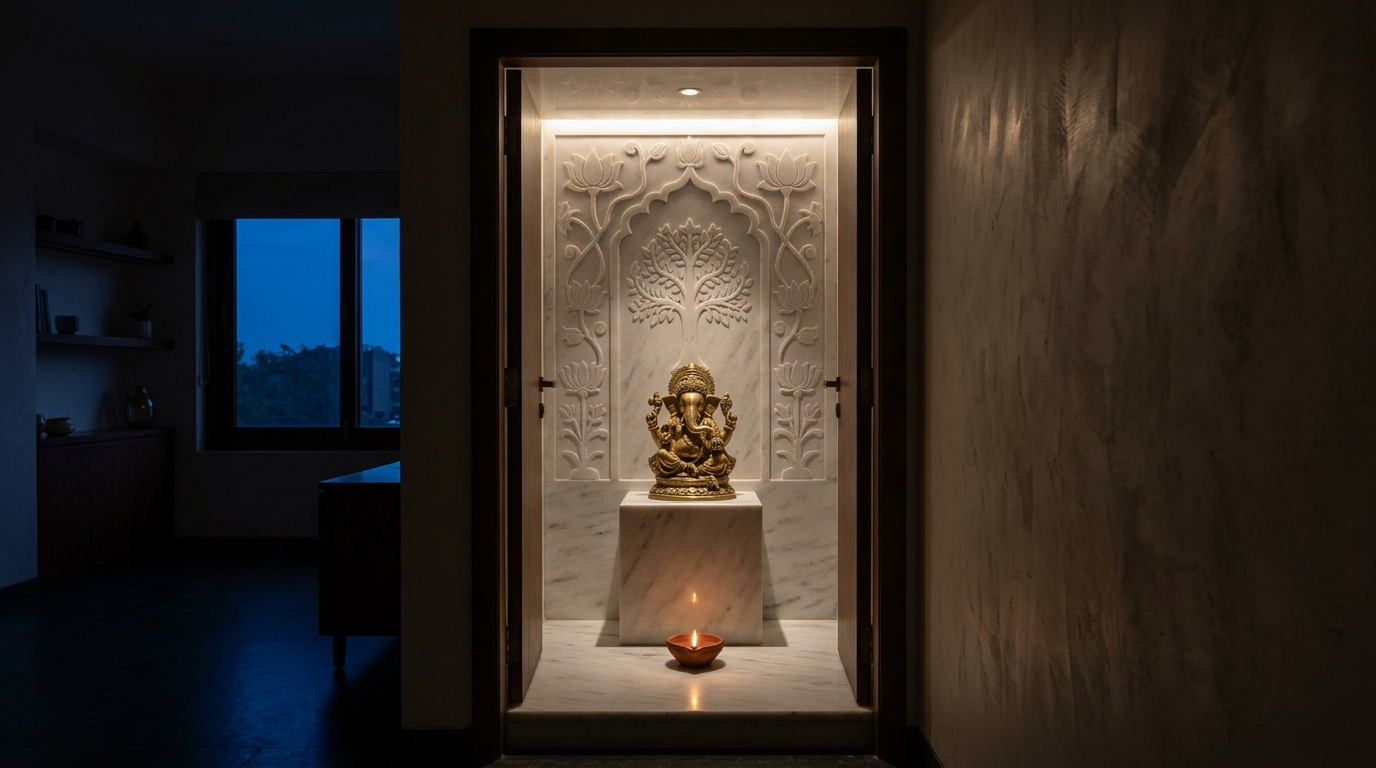
- The puja room is lit for a seated or kneeling viewer looking slightly upwards at the deity. Every source must be hidden from that eyeline.
- Light the idol and the back wall, not the room. A narrow, warm accent with a soft surround reads as reverent; a bright downlight reads as a storeroom.
- Design around the diya. Electric light should support the flame, not overpower it.
A different kind of room
The puja room breaks most residential lighting assumptions:
- It is small, often a niche or a room under 2 m wide.
- It is viewed from a low eyeline, seated on the floor or kneeling.
- It contains reflective materials: brass, silver, polished marble, glass and gold leaf.
- It has a live flame for part of the day.
- Its mood matters more than its illuminance.
These conditions call for the principles in our beam angle guide, applied at close range.
1. Start from the seated eyeline
- The viewer’s eye sits at about 0.8–1.0 m when seated on the floor, often closer to the deity than in any other room.
- From there, the ceiling directly above the shrine and the top of the niche are in view. A downlight in the niche ceiling becomes a bright point just above the deity’s head.
- Hide every source from the seated position: recess deeply, place fittings behind a lintel or fascia, or light from the sides.
- Check the section from the seated eye, not the standing one.
2. Light the deity, then the back wall
The accent on the idol
- A narrow beam (around 10–20°, sized to the idol at the actual throw) focused on the face and upper body.
- Light from slightly in front and above, at about 30° from vertical, to model features without deep shadows under the eyes and nose.
- For a marble idol, a soft-edged beam avoids hard rings on the polished surface.
- For metal idols, check reflections from the seated position; brass and silver mirror the source if the angle is wrong.
The back wall and niche
- A gentle wash or graze on the back wall separates the idol from its background and gives depth.
- Carved stone or wood backs reward grazing from a concealed linear profile at the top or sides. See our linear profile guide.
- Gold leaf and mirror backs should be washed softly from a low angle; strong direct light turns them into glare.
The surround
- Keep the rest of the room low. Contrast between the shrine and the surround is what makes the space feel sacred.
- Using the conventions in our beam angle guide, a ratio of around 10:1 between the idol and the room reads as focused but calm.
3. Colour: warm, and rendered well
- Colour temperature around 2700 K or warmer. It matches brass, marigold, sandalwood and the flame. A diya burns at roughly 1800–2000 K; electric light much cooler than 2700 K beside it looks harsh.
- Good red rendering. Kumkum, red cloth, flowers and skin tones need high R9. Specify Ra ≥ 90 and R9 ≥ 50 as a minimum convention. See The Colour of Light.
- Dim-to-warm fittings that warm as they dim suit evening aarti, when light is lowered and the flame takes over.
4. Designing around the diya
The flame is the most important light in the room during prayer.
- Lower the electric light during aarti. A dedicated “puja” scene sets the accent low and the surround lower, letting the diya and its reflections in brass become the focus.
- Keep fittings clear of heat and soot. Do not place profiles or downlights directly above the diya position. Soot discolours diffusers and heat shortens LED life.
- Allow for incense smoke. A narrow beam through smoke becomes visible as a shaft of light. It can be beautiful, but sealed optics are easier to clean.
5. Niches, cabinets and apartments
Many apartments have a puja cabinet rather than a room.
- Concealed linear light at the top front edge of the niche, aimed back towards the deity and the back panel.
- Small, deeply recessed spots in the niche ceiling only if they cannot be seen from the seated eyeline.
- Shallow cabinets need low-output, well-diffused sources; a strong spot at 300 mm creates a hot spot and harsh shadows.
- Glass shelves benefit from edge or back lighting rather than downlight from above.
6. Control
- A separate circuit for the puja accent, independent from the room.
- A puja scene: accent at a set level, surround low, ready with one press or one voice command. See Scene Control.
- Dimming to very low levels for night, when a faint glow on the deity is enough.
- Optional time-based scenes for morning and evening prayer.
Specification notes
- Check every fitting position from the seated eye at about 0.8–1.0 m.
- Accent the idol with a narrow, warm (≤ 2700 K), soft-edged beam at about 30° from vertical.
- Wash or graze the back panel separately; keep the surrounding room low.
- Specify Ra ≥ 90, R9 ≥ 50, and dim-to-warm where possible.
- Keep fittings away from the diya position; use sealed optics.
- Provide a dedicated puja scene on its own circuit.
Frequently asked questions
What colour light is best for a puja room?
Warm light around 2700 K or warmer, with good red rendering. It matches brass, flowers and the diya, and feels calm rather than clinical.
Should I use a downlight above the mandir?
Only if it is deeply recessed and cannot be seen from the seated position. A visible downlight above the deity becomes a bright point in the eyeline and flattens the idol.
How do I light a small puja cabinet in an apartment?
Use a concealed linear light at the top front edge aimed back towards the deity and back panel, with low output and good diffusion. Avoid strong spots at very short distances.
Continue the series
- Beam Angle in Lighting Design
- Beam Angle in Living Spaces
- 2700 K vs 6500 K in Indian Homes
- Lighting Controls for Architects
- Scenes, Not Switches
About the author
Prem Rout, Founder of JMAP Solutions, set up in 2022 to deliver lighting, automation and building management solutions from Bhubaneswar. Over 15 years of experience in building products, construction and project business development across Mumbai and Odisha, working where design intent meets specification and site delivery. Connect on LinkedIn.


