In short
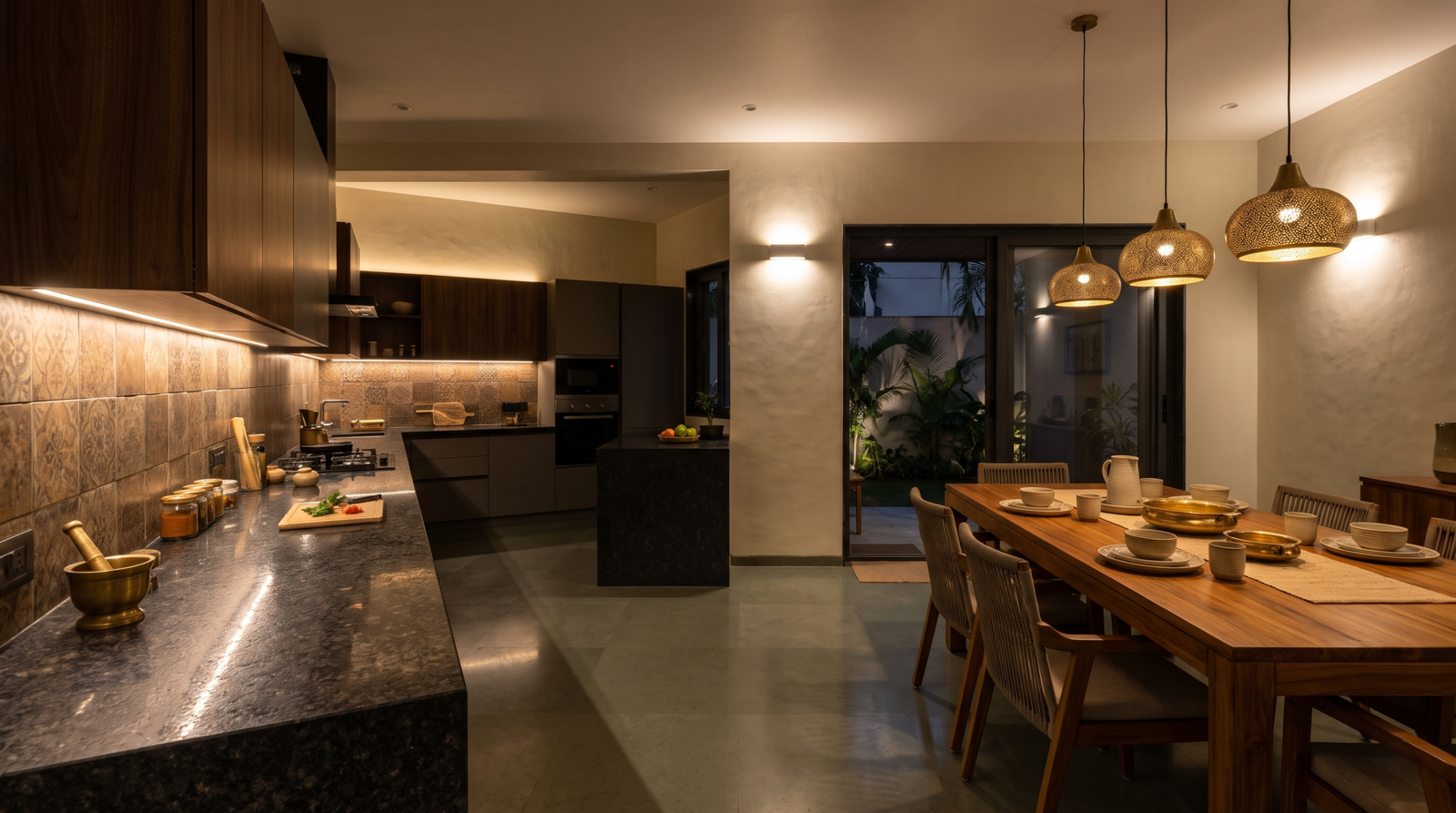
- Light the counter, not the floor. Ceiling downlights behind the cook throw the body’s shadow onto the work surface.
- The dining table is lit for faces and food. Warm light with good red rendering, aimed at the table, with a soft surround.
- Separate circuits for task, ambient and dining so the kitchen can be bright for cooking and quiet for dinner.
The Indian kitchen
Indian kitchens are intensive working spaces: chopping, tempering, rolling rotis, long cooking sessions, frequent cleaning. They often have:
- Long counters along walls, with tall units above.
- A separate wet or service kitchen.
- Granite or quartz counters, often polished.
- Heat, steam and oil, which affect fittings and finishes.
- Household staff working alongside the family.
The lighting must be practical first, then pleasant.
1. Counter task light
- Problem: downlights in the ceiling centre light the floor and throw the cook’s shadow onto the counter.
- Solution: under-cabinet linear light, set towards the front edge of the wall unit, lighting the counter directly.
- Where there are no wall units: downlights or a slot positioned above the counter’s front edge, aimed so the light falls in front of the cook rather than behind.
- Optics: frosted or opal diffusers to avoid dots and reflections on polished granite. See Opal, Frosted or Lens.
- Levels: counters need higher illuminance than circulation. Use the applicable standard or project brief for target values.
2. Ambient and vertical light
- A modest ambient layer from downlights, a cove or a slot along the ceiling.
- Lighting the tall units or a feature wall reduces contrast and makes the kitchen feel larger. See Light the Walls.
- Inside tall units and pantry cupboards, door-activated lights help.
3. Colour in the kitchen
- Colour temperature: 3000 K as a base; 3500–4000 K for the counter line if the household prefers crisper task light. Keep one temperature per plane. See 2700 K vs 6500 K.
- Colour rendering: Ra ≥ 90 with good R9, so turmeric, chilli, greens and the colour of oil and tempering read correctly. See Beyond Ra.
4. The dining table
Pendants
- Hang pendants so their light falls on the table and the source is not in seated eye level. A common starting point is around 700–850 mm above the table top (convention); adjust for the pendant’s shielding and the room.
- Long tables suit a linear pendant or a row of two or three pendants.
- Choose pendants with shielded or diffused sources. A bare bright lamp at eye level across the table is glare.
Accent from above
- Narrow or medium beams from the ceiling, aimed at the table, make food and tableware glow while leaving faces softly lit by reflected light.
- Avoid downlights directly above diners’ heads; they create harsh shadows on faces.
Surround
- Keep the surrounding room lower than the table. Contrast makes the meal the focus.
- A wall wash or lit sideboard gives depth behind the table.
5. Scenes
| Scene | Counter task | Ambient | Dining | Purpose |
|---|---|---|---|---|
| Cooking | 100% | 60% | 30% | Full task light |
| Dinner | 20% | 10% | 70% | Focus on the table |
| Cleaning | 100% | 100% | 50% | Everything visible |
| Night | 5% (under-cabinet) | 0% | 0% | Path and water |
Scene design and keypads are covered in Scenes, Not Switches.
Practical details
- Heat and grease: keep fittings away from the hob and chimney hood; choose sealed, easy-clean fittings near cooking.
- Moisture: use suitably rated fittings near sinks.
- Switching: under-cabinet lights on a switch or sensor at the counter, not only at the door.
- Service kitchen: simpler, brighter, cooler light is acceptable; it is a workspace.
Specification notes
- Light the counter from the front edge of wall units or from above the counter’s front edge.
- Use frosted or opal under-cabinet optics over polished stone.
- Specify Ra ≥ 90 and good R9 for kitchen and dining.
- Hang dining pendants with shielded sources, typically around 700–850 mm above the table.
- Keep the dining surround lower than the table.
- Circuit task, ambient and dining separately; provide cooking, dinner, cleaning and night scenes.
Frequently asked questions
Where should lights go in a kitchen?
Over the work surfaces, not just the centre of the room. Under-cabinet lights at the front edge of wall units remove shadows on the counter.
How high should a pendant hang over a dining table?
Often around 700–850 mm above the table top, adjusted so the source is not in seated eye level and light falls on the table.
What colour light is best for a kitchen?
A 3000 K base with a 3500–4000 K counter light suits many Indian kitchens. Good colour rendering matters more than the exact temperature, so food looks right.
Continue the series
- Beam Angle in Lighting Design
- Beyond Ra: Rendering Food and Materials
- Opal, Frosted or Lens
- Scenes, Not Switches
- Glare Beyond UGR
About the author
Prem Rout, Founder of JMAP Solutions, set up in 2022 to deliver lighting, automation and building management solutions from Bhubaneswar. Over 15 years of experience in building products, construction and project business development across Mumbai and Odisha, working where design intent meets specification and site delivery. Connect on LinkedIn.


